

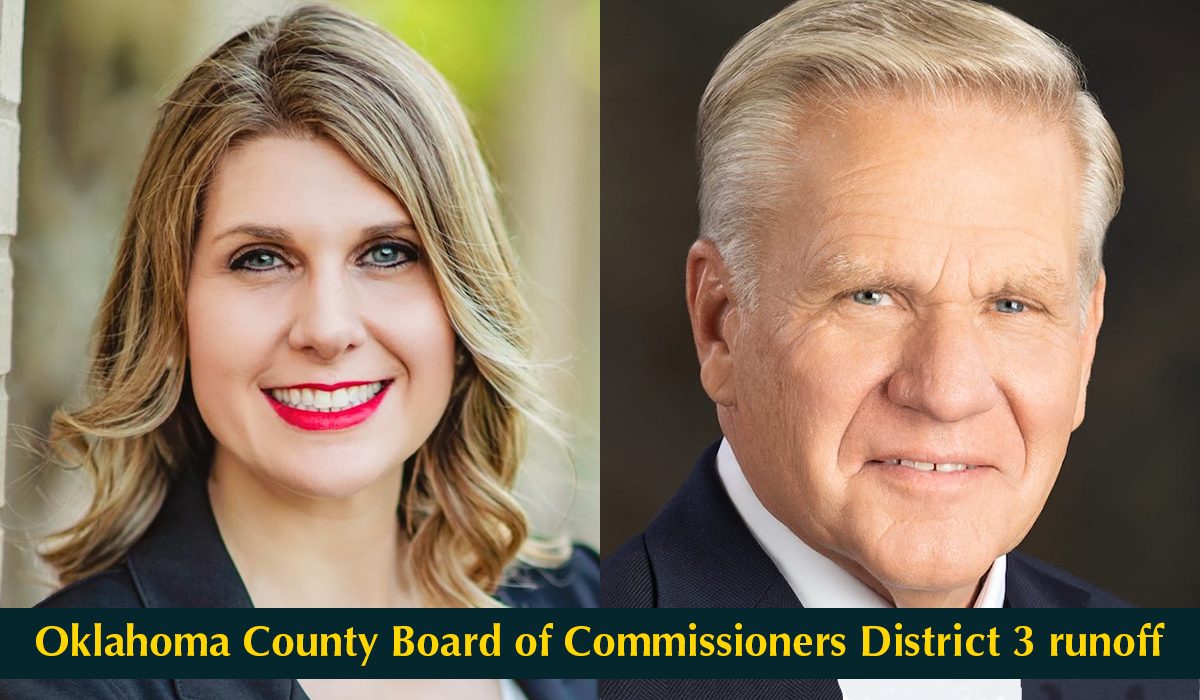

Jessica Clayton, forming plans from her county manager experience, and Alex Warren, aspiring to use his business skills to shake things up, advanced to the Aug. 25 Republican runoff for the open District 3 seat on the Oklahoma County Board of Commissioners.
Warren, a local business owner and the brother of County Court Clerk Rick Warren, said if voters choose Clayton they will not see change.
“Jessica is from the inside. You’ll get the same kind of results that you get from [District 2 Commissioner Brian Maughan], and she’s going to vote the way Brian wants,” Warren said.
Clayton, who worked as Maughan’s chief deputy before being hired as the county’s first administrative manager, frames her four-year tenure as her strongest qualification.
“Before I worked in the county, there was no way I could have worked as a county commissioner. We have so many challenges ahead of us (…) and so we need strong leadership,” Clayton said. “We need somebody with experience. We do not have time for somebody to try to figure out where they’re supposed to park or what a county commissioner does.”
The candidates are vying for the seat left vacant when former District 3 Commissioner Myles Davidson resigned amid allegations of sexual harassment and assault.
Asked if she had been aware of the allegations against Davidson before they became public, Clayton deferred to the lawsuit naming the commissioners.
“I don’t want to overstep and say something I don’t have the authority to say,” Clayton said. “Trust is important, and that is something I want to rebuild throughout our community. That comes through transparency and consistency. (…) My ultimate goal is being a commissioner that they can be proud of and know that I have their best interests always at heart.”
Warren called Davidson’s behavior “a product of that environment” and said commissioners should have turned him in to the district attorney.
“I believe there’s a lot of entitlement there, and I think [Davidson] probably made mistakes before they got to that point,” Warren said. “As far as being worried about that, you’ll be hard pressed to find one thing on me that is bad. (…) If you look at my name, it’s clean. It was given to me by my father. He passed away, but when I see him in heaven, I’ll give him his name back and it will be clean, too.”
Clayton finished atop the five-candidate June primary with 41.8 percent support. Warren narrowly edged out Wendy Jo Hampton by eight votes to make the Aug. 25 runoff. The winner will face Democrat Jennifer Mayo in November.
Warren: ‘People have been dying’

Both candidates identified the Oklahoma County Jail as the biggest challenge facing the next District 3 commissioner. The Board of County Commissioners is poised to vote Wednesday on whether to send a sales tax proposal to the November ballot. The tax would be four-tenths of 1 percent and would last for 25 years, funding what commissioners hope it would take to complete the new jail plotted for southeast OKC.
Spanning Oklahoma County’s northern boundary, District 3 includes far northwest OKC, Edmond, Arcadia and Luther.
Clayton said “it would have been wonderful” to have a solidified plan for funding before the county purchased land for its new facility and broke ground on the behavioral health center.
“The challenge is we don’t have enough money in order to complete that project, and then we have a detention center that has a lot of issues and we continue to have deaths at. And so the problem is we don’t have enough funds in order to build, or finish, the detention center that the commissioners had set out to build. But if we don’t complete that project and we continue to serve and hold detainees at our current detention center, those deaths or anything like that that happens there could potentially end up in lawsuits and on our property taxes,” Clayton said. “My goal would be to put together solutions in regard to how we can continue the construction that the commissioners had started because we’ve already invested in the behavioral care center.”
Warren emphasized the necessity of maintaining the current 30-year-old jail building.
“We are obligated to maintain that building. It should not be in the conditions it is in. The people that have been there in the past should have been taking care of it. So once we get that jail taken care of, we can decide if we want a new jail,” Warren said. “If we want a new jail, we have to decide how we’re getting that money. But we have to have plan how we’re going to build it, where the money’s coming from and where it’s going.”
To bring the care center and the new jail to completion, Clayton sees a sales tax as the way forward. While she did not discuss Wednesday’s proposed vote specifically, it will be the third such proposal this year.
“I want the community to be able to weigh in, but I also want to make sure we’re asking for enough funding and we’re not in the same situation that we are now,” Clayton said. “We need to research what that looks like and then give the citizens an opportunity to weigh in on what those funds are used for whenever the detention center is finally built.”
Warren said the jail trust has not proven its effectiveness, and he would ask them to step back.
“I’ve been watching [the county] for a very long time, but just since I’ve been running, since October, we’ve been talking about that jail. People have been dying and no one’s done nothing about it,” Warren said. “The day that I’m elected, I will start doing things with that jail. The minute I’m elected, I’ll get a sheet, find out what the punch list is on that and get them taken care of.”
Clayton said her experience working for Oklahoma County makes her the better candidate.
“This allowed me to be able to really work shoulder-to-shoulder with all the departments, understand the needs and be able to fix and improve a lot of our budgets, improve a lot of the inefficiencies we had in regard to purchasing and provide them support,” Clayton said.
As county manager, Clayton oversees engineering, planning, facilities, human resources, IT, the Free Fair Association and emergency management.
“Unless you’ve served in that capacity and you know from the boots-ground level of what’s going on at the county — all the issues, the problems I’m able to help provide solutions for every day — it just made me an incredible candidate for county commissioner,” Clayton said.
Warren said that when he looks at the commissioner’s office, he sees ways he can help.
“In business, you have to move quickly and very smart and effectively, and I think I do that,” Warren said. “I can get some things done, like the jail and the money that they’re spending, I can keep them in line. I handle $5 million budgets and payrolls, so I can get contracts.”
Clayton: More proactive than reactive to road repair

In interviews, both candidates revealed biographic details. Clayton said a fun fact about herself is her love of animals. She has three tortoises, one that is almost 200 pounds, and eight parrots.
Warren said he likes to have a good time and see things in a brighter light, even when he makes a mistake.
“Someone asked me, ‘Alex, if you’re committed to something and you find out you’re wrong, what do you do?’ I laugh at it, fix it, and I admit my mistake,” Warren said. “I don’t take things [to] heart. I’m lighthearted.”
Each candidate emphasized the importance of county road and bridge work, with Warren saying project priorities will be the first thing he plans to assess.
“[The county] quickly realized they have to fix Waterloo before they [fix 33rd Street, 15th Street and 2nd Street] because they didn’t have the budget. So they’re fixing Waterloo, and they’re getting a bridge. That’s what I would evaluate: where they’re working at and how they came to prioritize those,” Warren said. “I would see if we need to prioritize some of them because things change everyday.”
Warren also mentioned the importance of installing proper drainage.
Clayton said the county needs to facilitate better communication about roads and stretch the taxpayer dollars to fix them.
“We have $140 million in backlog, and we have got to be more proactive than reactive in regard to the roads that we’re repairing. I want to be able to use grants in order to offset a lot of that cost, and I’m excited to be able to have the opportunity to utilize that skill set to do that,” Clayton said.
Concern over data centers is a prevalent discussion in District 3, as Oklahoma City, Edmond and Luther have passed varying memorandums.
Warren views data centers as “unavoidable.”
“As [data centers] develop, as they evolve, you’re going to see them get quieter. You’re going to see them use less water, and they’re going to have to adapt to what their community is holding them to. Until that happens, it’s going to be a slow and rough road,” Warren said. “As we grow, we’re eventually going to have to look at having them, and it’s unavoidable. You just have to be careful on how you accept them.”
Clayton offered a cautious approach.
“We need to make sure that we have infrastructure for that. Our water is a vital resource for us,” Clayton said. “I do have concerns as a taxpayer myself making sure that we protect our water because it is a vital resource for us.”
Clayton highlighted a duty beyond road repair that falls to commissioners.
“Anytime there’s inclement weather, or anytime there’s any type of natural disasters such as a fire, tornado, to be able to be there to support our citizens at those times, it’s all hands on deck whenever anything like that happens,” Clayton said.
Warren mused at Oklahoma’s 100-year history electing county commissioners in his explanation of how he views a commissioner’s role.
“[The commissioner] is your neighbor, he’s the guy you go to church with. He’s the guy you know him by first name. You have his phone number. You can reach out to him, he is over your roads, your bridges, your county buildings. He’s over the day-to-day maintenance of what the county does, the business that they handle,” Warren said. “He’s the guy you can go to if you need and get things done, get things answered. Their umbrella is very vast, though. You can’t just put them in a little spot and say, ‘They’re doing roads and bridges,’ because they do so much more.”
Before working at the county, Clayton wrote grants for Daily Living Centers, a metro nonprofit that provides adult day services.
“It was a situation where I walked into a nonprofit organization that was on the brink of failure. It was in the middle of COVID, serving the most vulnerable of senior adults and adults with disabilities,” Clayton said. “I was able to write grants in order to help them get back on track in regard to their financial well-being.”
Asked what differentiates him from Clayton, Warren touted the financial accountability he learned from 22 years of business experience working for Regis Corporation, a Fortune 500 hair salon company, and starting his own business.
“I stayed in the top-two bracket, always, and that means coming in under budget and showing a profit,” Warren said. “The difference in that job and being a county commissioner is, if you don’t show a profit and you’re out of budget, you’re gone,” Warren said.