
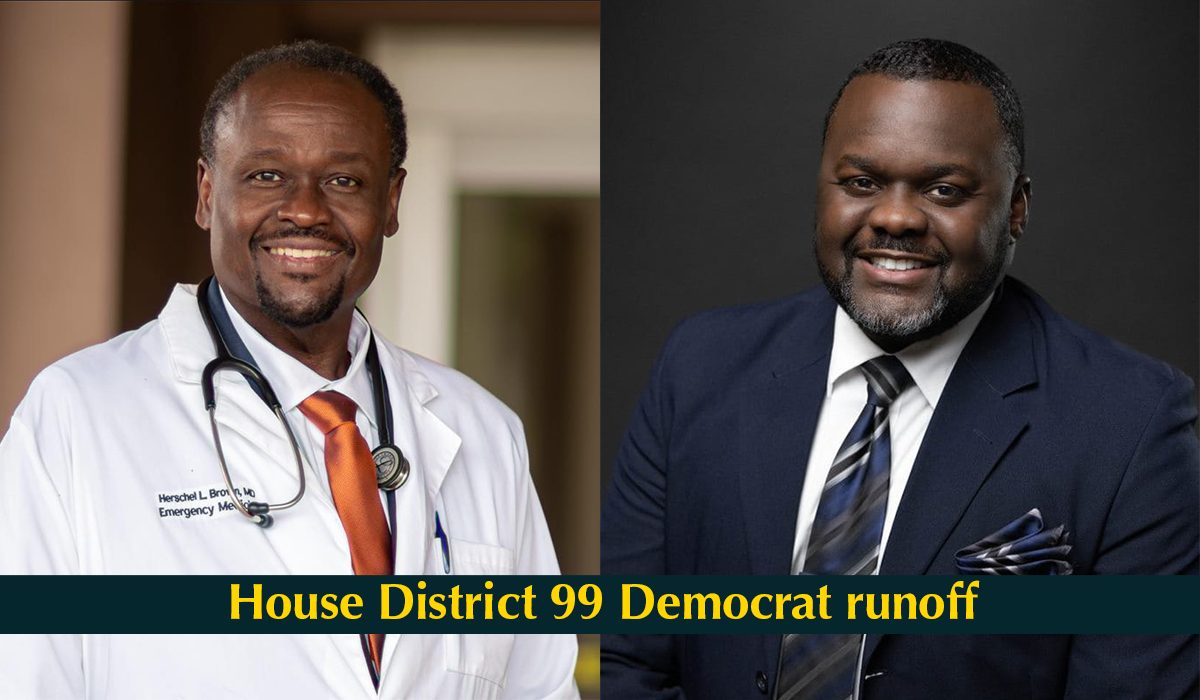

In a matchup pitting a doctor of medicine against a doctor of philosophy, Herschel Brown and Carlos Robinson have centered their candidacies on community involvement as they seek the Democratic nomination for the open House District 99 in Oklahoma City.
Robinson holds a doctorate in education with a focus on administration and leadership from Southern Nazarene University, while Brown graduated from the University of Oklahoma College of Medicine and is an emergency room physician at OU Health.
“The biggest [thing] I stand on is my involvement in the community,” Robinson said. “I’ve always been apart of this community, and so when you start to look at both candidates, it kind of boils down to who do you know (…) that won’t come into the Capitol needing training wheels.”
Brown also described himself as an active community member.
“[A constituent] can say, ‘Look, this is a guy who’s been here, who’s worked here, who’s been in the community. Who is an educator, who is a healthcare [leader], who’s also a small business owner — that he knows these issues and therefore this person would be great for us,’ Brown said. “And District 99 needs that person at this time, especially after the [situation] we had earlier this year.”
The candidates are vying to represent the northeast OKC seat left vacant when former Rep. Ajay Pittman resigned in January and pleaded guilty to three felony charges.
“There’s no skeletons in my closet,” Brown said. “My whole life and career has been one that I always wanted to make sure that I had credibility, I had moral values. (…) I’m the coolest L-seven that you know. If you put your fingers together, you put an ‘L’ and a ‘7’ it shows a square. So I’m a pretty square person, but I feel like that’s what’s needed. We needed somebody that goes up there that has the dignity, the honor, the credibility, the education and has been in this community for my whole life and working in it for at least 30 years.”
Robinson also touted his track record as completely “transparent” while discussing how HD 99 needs new representation.
“People make mistakes. I don’t know how her mistake happened, but I’m sure, as an individual, her heart was in the right place. But you know, absolutely, things happen and you [have got to] be held accountable to those things that happen,” Robinson said. “I’ve been transparent my entire life. [There’s] almost nothing you could find on me that will bring into question my integrity, my accountability, my transparency, because that’s who I’ve always been.”
Brown said Robinson is a good man and recognized his hard work in terms of economic development.
“I’m going to tell you right now, the biggest thing that differentiates me from him is that one, I have the experience,” Brown said. “I have the knowledge about healthcare and education that I believe not many people have, and I don’t believe my opponent has that.”
Robinson said that, if he is not elected, the person who is will likely need his assistance anyway.
“If we chose another candidate other than me, (…) that person will probably have to lean heavily on my advice to navigate in a large portion of District 99 because that person hasn’t been as involved in the district over the years,” Robinson said. “Great career, but not the involvement that a state representative will need on all aspects of community development.”
HD 99 covers a swath north and east Oklahoma City, running from the intersection of Reno Avenue and Martin Luther King Avenue up to the intersection of May Avenue and Northwest 122nd Street. The winner of the Aug. 25 runoff will face a Republican opponent, Melvin Latham, in November.
Polls will be open from 7 a.m. to 7 p.m. Tuesday, Aug. 25. Early voting is set to take place from 8 a.m. to 6 p.m. on Aug. 20 and 21, as well as from 8 a.m. to 2 p.m. Saturday, Aug. 22.
Brown: ‘We have problems with access to healthcare’

Brown said people have told him the House of Representatives needs a physician.
“With me being an emergency medicine doctor, healthcare, to me, is vital to this community,” Brown said. “Right now we have problems with access to healthcare and affordability to healthcare, and that’s concerning. [Some legislators are] trying to basically change the constitution because the Oklahoma people voted to expand Medicaid, and now they’re trying to change it. (…) I don’t agree with that. Everyone should have access. That’s probably my No. 1 thing.”
Robinson is currently the CEO and president of the Oklahoma City Black Chamber of Commerce.
“I’m working with an ecosystem of economic development, which can go hand-in-hand with all my years of experience in higher education and workforce development,” Robinson said. “And then God called me to run for state representative. I had a number of signs, just everybody saying, ‘Hey, you’ll be a great person for that role.'”
Brown said he learns about issues constituents face daily when he sees patients seeking care without insurance.
“I feel like [legislators] don’t understand if [they’ve] never experienced it,” Brown said. “My middle son has autism, and our Oklahoma insurance company had always paid for what’s called Applied Behavioral Analysis for years. And then all of the sudden, it just stopped. We didn’t understand why. I started looking into it, and then they told me that the insurance companies actually lobbied the Legislature to change the law requiring Oklahoma insurance companies to cover that care. People can’t pay for that.”
Robinson sees economic growth as the starting point for improvements in other areas.
“If we can rebuild through economic development, those businesses can pour off into the greater needs of the community. Whether it’s pouring into education (and) making sure we have teachers paid accordingly,” Robinson said. “It’s not one need more pressing than the other, but if I had to categorize what are the most pressing needs, I believe economic development of the community would be an answer (…) because you’ll be able to circulate the proper funding throughout the community.”
Brown, who also supports increasing teacher salaries and finding ways to assist seniors with property taxes, said his second most important priority is education, a topic he has become more familiar with as a board member of the Northwest Classen High School Academy of Health Sciences, where he attended high school.
“If we don’t have the education, how are we going to educate our young people into jobs and skills that they really need to have? We don’t fund it at the level we need to, and this is another concerning issue for me,” Brown said.
Robinson: ‘I knew higher education was different’

In interviews, both candidates offered fun facts about themselves and deeper biographical information.
Brown still has a landline at his house, and he said his favorite book is Dr. Michael Greger’s How Not to Die, a discussion of healthy eating and a plant-based diet.
Meanwhile, Robinson said that, despite his “poker face,” he “cracks a lot of jokes” and can be “pretty hilarious.”
Brown attends Voice of Hope Church and serves as a health minister, men’s ministry leader and an elder.
“To me, you have to be a part of the community, and you have to be a part of your church,” Brown said. “We do a thing where we reach out every month — which we call CIA, which is Christians in Action. (…) We went out to feed the homeless. We have what’s called the Hope Street Kitchen we do every Sunday. The men’s ministry went out and passed out toiletry items to the homeless. This is something I just feel passionate about, that we give back to the community.”
Robinson’s religious roots stem from his great grandparents’ attendance at St. John’s Baptist Church and Emmanuel Baptist Church.
“I don’t have a church home. I kind of call it church-hopping,” Robinson said. “I’m just following my spiritual journey. As I jumped on this campaign, I went to each of those churches that had significant impact in our community. So it’s kind of just been an interesting thing to go to all of these different churches and just see how they worship, and just get to hear their stories and walk the steps that my great grandparents walked initially. It’s been a pretty enlightening experience.”
Brown said he is in the community to serve his neighbors.
“I’ve always loved this community. It’s just a part of me,” Brown said. “I’m a religious person, but you know when you look at Luke 12:48, it states in there, ‘To whom much is given, in return much is required.’ I feel I have been blessed beyond compare with the ability to be a physician. God gave me that knowledge, and I’m just a vessel. I’ve served the community as a doctor, but now I want to serve them at a higher level and make sure that I have laws and things that will make their lives better.”
Robinson said his whole life has prepared him for campaigning through numerous leadership role. At 16, Robinson led the dance group Sex Mob, which he said he did not name.
“[The dance group] really kept us off the streets. That was an avenue to express ourselves in a manner that really kind of navigated us away from the negative lifestyle,” Robinson said. “At the age of 16, I was a leader of about 100 guys. (…) It kept us off the street, and it saved my life.”
Brown critiqued cuts to mental health services because he said he sees the effects in the emergency room.
“I see people every day that are struggling with so many different types of challenges with mental health — anxiety, depression, suicide — and for us to cut those funds is just not where we need to be,” Brown said. “For me, going to the state Legislature, they’re going to have someone that knows the issues.”
In addition to his doctorate, Robinson holds a bachelor’s degree in business administration from Oklahoma City University and a master’s in business administration from SNU. Asked what inspired him to pursue higher education in the business field, Robinson said a college advisor guided him.
“That really kind of came about when I talked to my academic advisor and she was asking, ‘So what do you want to do?’ And me being a first-generation college student, I really had no idea,” Robinson said. “But I knew higher education was different. I wanted to see something different. (…) So I told my academic advisor, I said, ‘I just don’t want to work for anybody.’ She laughed and said, ‘Well, it sounds like you want to be a business major.'”