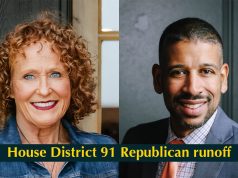

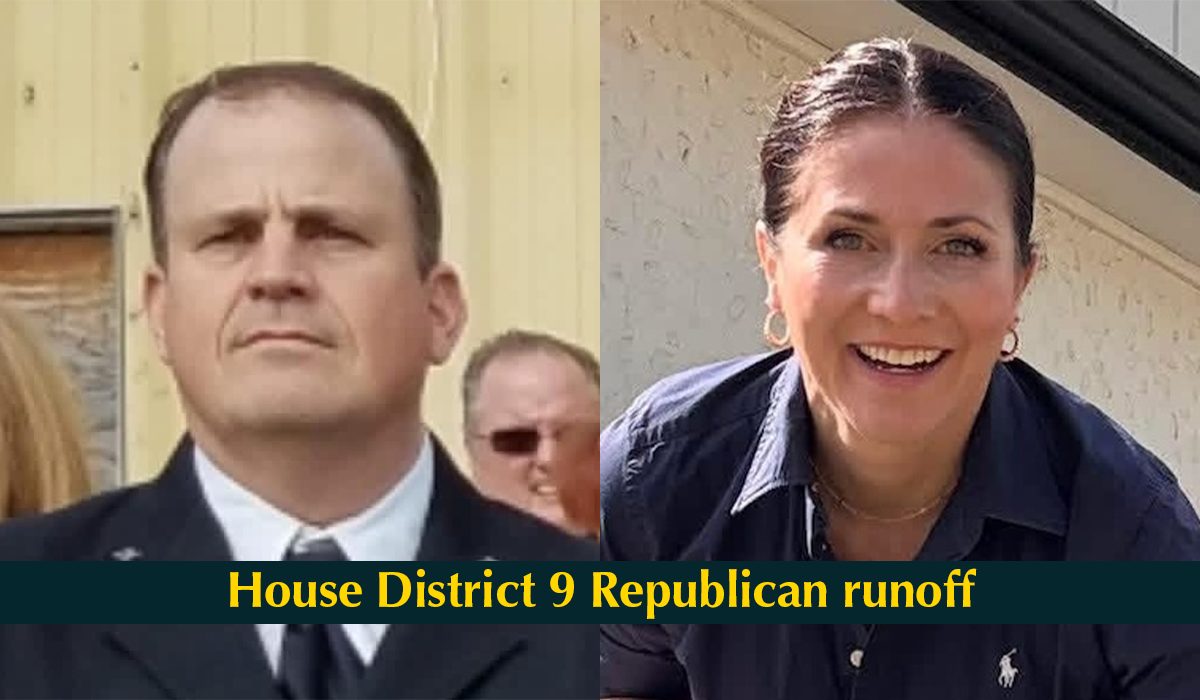

A former congressional field representative and a career emergency manager are competing in northeast Oklahoma’s HD 9 runoff, and both say the proposal for a massive aluminum smelter just across their district’s border is already shaping what voters want to know about them.
Crystal Campbell, a 50-year-old former staffer for then-U.S. Sen. Markwayne Mullin, and Scotty Stokes, a 59-year-old firefighter and Rogers County’s emergency management director, advanced from a three-way June 16 Republican primary in which no candidate cleared 50 percent. Stokes led with 42.57 percent support (2,041 votes), followed by Campbell at 33.5 percent (1,606 votes).
Both candidates agreed to interviews in Tulsa ahead of the Aug. 25 runoff, and each said understandable concerns about the aluminum smelter project should spur more study of its impacts.
The Emirates Global Aluminum smelter — proposed to be the largest in the world — is set for development in Inola’s neighboring House District 8, which borders HD 9. The project secured a $225 million state rebate and a $500 million U.S. Department of Energy grant, but its industrial waste and projected electricity draw of more than 1,000 megawatts — equivalent to about 20 percent of Public Service Company of Oklahoma’s generation portfolio — have alarmed many constituents.
“Even though it’s not in our district, it’ll affect the people in our district,” Stokes said. “With the prevailing winds out of the south, it will definitely affect District 9 people.”
Campbell agreed the proximity demands scrutiny.
“I think there’s concerns that any time you have something like that — it is proposed to be the largest in the world — if we don’t ask the questions, that’s where gaps happen,” Campbell said. “I don’t think I could look somebody in the eye and go, ‘Yeah, I support something that ultimately caused your doom.'”
House District 9 covers parts of Rogers and Tulsa counties in northeast Oklahoma, including Claremore. The winner of the Aug. 25 runoff will face Democrat Andrea Biscardi in the November general election to succeed Rep. Mark Lepak (R-Claremore), who is term-limited.
Polls will be open from 7 a.m. to 7 p.m. Tuesday, Aug. 25. Early voting is set to take place from 8 a.m. to 6 p.m. on Aug. 20 and 21, as well as from 8 a.m. to 2 p.m. Saturday, Aug. 22.
Campbell: ‘Growth is coming’

Campbell grew up in Oklahoma and worked as a field representative for Mullin, who resigned from the Senate in March to become secretary of Homeland Security. She described a field rep’s role as being highly preparatory for the Legislature. She said constituent services work gave her hands-on experience navigating federal agencies, the Army Corps of Engineers, railroads and real estate disputes across northeast Oklahoma.
“The greatest thing about Markwayne is that he could say, ‘Go take care of it,'” she said. “He did not like to over-manage it. He said, ‘This is yours, go take care of your area.'”
Stokes, who spent 32 years in the Tulsa Fire Department before retiring as a captain and paramedic, said his own career has been built entirely on public service to Oklahomans.
“My life has been in service to the people of Oklahoma, and I just want to continue that service and continue that representation of the people of District 9,” he said.
On the smelter specifically, both candidates said they see the project’s obvious economic potential, but they drew firm lines around problematic potential consequences. Stokes noted the district is home to ranchers and farmers who could be directly affected.
“If you take out all the environmental concerns, the economic side of things is going to be potentially huge — 1,000 jobs right off the bat, and they’re talking up to 10,000 jobs,” he said. “But does it outweigh the concerns of the people that live in that area? A lot of ranchers, a lot of farmers — how does that affect the hay production and the cattle production?”
Campbell said she sees the national security argument for domestic aluminum production but said that cannot come at any cost.
“It’s something that the U.S. needs. We’re relying on China right now, and that does not put us in a great spot when it comes to manufacturing,” she said. “So it does have big potential. I see the exponential benefits of having this smelter, but I don’t want to do that at the risk of public health, agriculture health and the risk that could cause people.”
Stokes said he is pro-economic development but that safety and livelihood must be weighed equally. Campbell said she would need to hear every perspective before taking a formal position.
“You have to look from the proponent side, and you have to look from the anti-side, and then you put that together, and somewhere in there is going to be the reality,” she said.
On broader growth concerns in the district, Campbell said her background in residential development gives her a specific lens on what unplanned growth can cost communities.
“Northeast Oklahoma — everything that’s right around Claremore — growth is coming,” she said. “If we’re going to grow, we have to do this in a very thought-out, meticulous, smart way. You can’t just grow and go, ‘Oh, we forgot to put that in.'”
Stokes said constituents are already telling him the same thing, particularly around utility costs and water supply.
“Some of the biggest concerns that people are more worried about are rising utility costs and actual loss of some utility, loss of water,” he said. “They’re afraid that these large industrial complexes are going to come in and take all the water and cause issues for their personal water usage and rising utility rates.”
Campbell said the state needs a comprehensive plan for water infrastructure.
“Not just roads and bridges, but water infrastructure in particular,” she said. “If we grow, you can’t just patchwork your way through. You really need to have a plan.”
Stokes: ‘Those are quality knocks’

Stokes entered the runoff having outperformed Campbell in the primary despite being outspent roughly three to one.
According to campaign finance reports, Campbell raised $41,900 before the primary, including $33,400 from individual donors, $3,500 in PAC support from Northeastern and Western Oklahoma PAC, POWhER PAC and the State Chamber of Oklahoma PAC, as well as $5,000 in loans to herself. Stokes raised $13,376, all from individual donations except a $2,000 donation from Owasso Firefighters PAC.
Stokes said his primary lead came down to one thing: knocking doors and having thorough conversations.
“It’s getting out in the community and meeting your people,” he said. “Before June 16, I knocked over 4,000 doors myself. I wore two pairs of shoes smooth out.”
He described lingering at doors as a deliberate strategy rather than inefficiency.
“I call them quality knocks,” he said. “My wife would go, ‘You really got to get away from people.’ I’m like, ‘Yep, those are quality knocks.'”
Campbell acknowledged that Stokes had spent significantly more time in the district before she entered the race.
“He had 14 months on that — I had literally two months,” she said. “My name hadn’t gotten out there that I was even running.”
She said her fundraising support reflects relationships built through years of constituent work rather than institutional backing.
“A lot of it comes from people that I’ve worked with, people that know me,” she said. “They know what I’m about.”
Stokes said the runoff will be decided more by turnout than money.
“She’ll outspend me. It’s obvious she already has,” he said. “But it’s going to come down to who can get their support to the voting (booths).”
Campbell said the low primary turnout — HD 9 saw roughly 4,700 votes out of about 18,000 registered Republicans — signals an opportunity for both candidates.
“First, vote,” she said. “We need to vote. We need voter engagement.”
Campbell: ‘FEMA was not designed to handle Oklahoma-type weather’
HD 9 includes Claremore, which was struck by an EF3 tornado in May 2024. Stokes led the Rogers County emergency management response to that disaster. Both candidates said the state should take more control because FEMA‘s structure is misaligned with the kind of disasters Oklahoma faces.
Campbell said FEMA was built for hurricanes, not Oklahoma’s weather pattern.
“It would be really great to kind of figure out a way to put that control back into the state’s hands,” she said. “If that control is back in the state’s hands, we could do a much better, more efficient, better use of money, resources and people’s time. There’s a reason it’s called the Oklahoma Standard. Why are we not leading the way on how we handle disaster here?”
Stokes said he agrees the state should serve as a model but pushed back on the idea of eliminating federal disaster funding entirely.
“I don’t think they need to just kill FEMA and let the states deal with it,” he said. “We’re the No. 3 state in the country for federally declared disasters, and we’re one of the smaller populations. So the funding at our state level just wouldn’t be there to take care of these communities as well as they should.”
He said the answer lies in better pre-planning at the state level, pointing to the 2024 tornado response as an example of what that looks like.
“Even people from the state said this is one of the best-run incidents they had been a part of in many years,” he said. “We were able to get those roads shut down, get those people kind of slowed down that were just coming in to help, and let them know: We’re only accepting vetted resources at this time.”
Campbell said she has already begun conversations with U.S. Sen. James Lankford (R-OK) about reforming the federal-state disaster relationship.
“They’re looking and researching ways that we can do that better, so that people in Oklahoma get better support for situations like Claremore,” Campbell said.
Follow @NonDocMedia on:
Facebook | X | Text or Email
Stokes: ‘Represent the average people of the community’
Both candidates said education is among their top priorities, and each said Oklahoma’s persistent ranking near the bottom nationally is unacceptable — though they approached the problem from different angles.
Stokes said the state should stop reinventing the wheel and look at what other states have done successfully “to build from their foundation.”
“Somebody has to be No. 50, and somebody has to be No. 1 in the rankings. But can number 50 improve? Yes, absolutely,” he said. “We should be able to move way up on that list.”
Campbell said the Legislature can only do so much without parents engaging at home.
“This is where it gets really frustrating,” she said. “I would hope we start a campaign to say, ‘Parents, you’re tired of being last. Make education a priority.’ We could turn it around so much faster.”
She also pointed to discipline as an under-addressed issue driving teacher burnout.
“The teachers that can’t teach because they’re not getting respect in the classroom — they were never intended to raise a child,” she said. “Big difference, and we put a huge burden on our teachers to raise our kids, and that’s not their job.”
Stokes said he would also push for stronger parental rights in education.
“In no way should the government force somebody to be educated in a certain way, and that’s something I would stand against wholeheartedly,” he said.
In terms of a specific legislative priority, Stokes said he wants to revisit HB 1675, a new law passed this year requiring youth camps and outdoor programs to conduct hazard assessments and develop emergency action plans. The issue is personal: Stokes founded the Oklahoma Firefighters Burn Camp after noticing the state had nothing for children who survived serious burns. He served as its director for 20 years.
But Stokes said HB 1675 was written too broadly, placing responsibilities on local emergency management directors that they have no legal authority to fulfill and using language vague enough to include youth gatherings like baseball tournaments far beyond the bill’s intended scope.
“It even says in that new act that the local emergency management director can shut them down,” he said. “We have no authority. Emergency management has no authority over other entities.”
Stokes said the bill’s intent was right but its execution was rushed.
“We need to rein this in a little bit and make sure the bill actually fits the need for what it was intended,” he said. “I think it was done with haste and with just a feel-good attachment to it.”
Campbell said her goal for constituents ultimately comes down to something straightforward.
“I want to hear from you, I want to learn from you, and I want to help you,” she said. “That’s why anybody should do this — to make life easier and better for somebody else.”
Stokes said he wants voters to see his decades of public service as the clearest argument for sending him to the Capitol.
“I just want to continue that service at the state level and add a little more common sense to the State Capitol,” he said. “[We need] somebody in there that will actually represent the average people of the community.”