

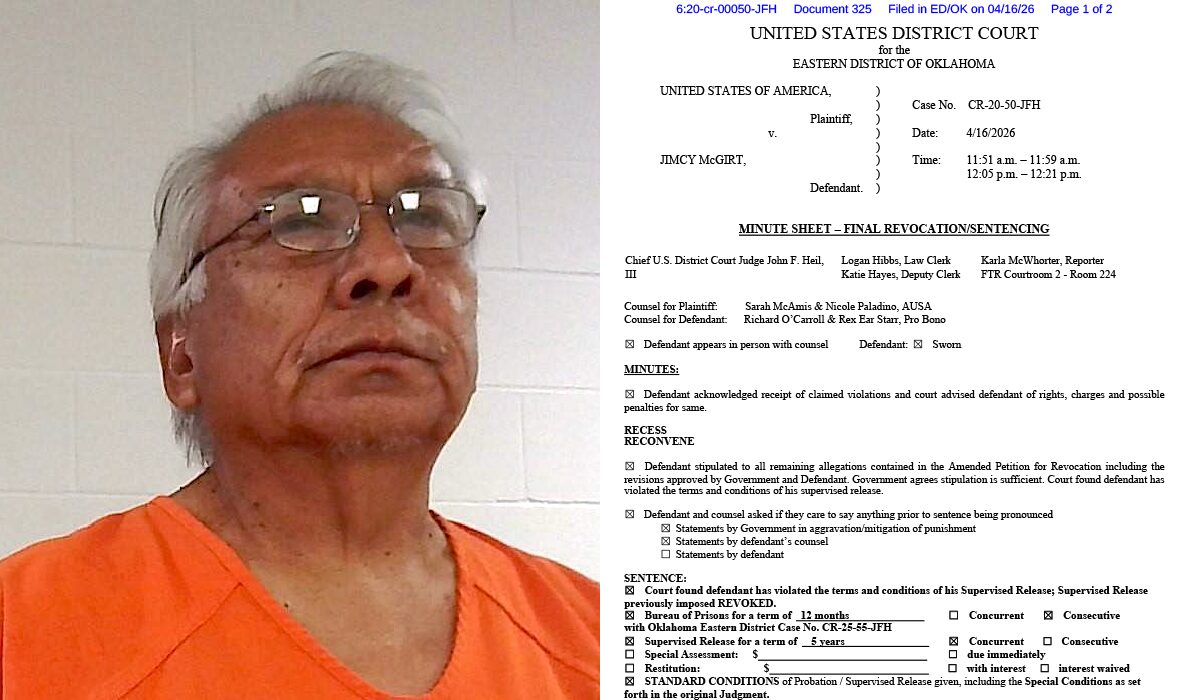

MUSKOGEE — Citing a rules “misunderstanding” for his probation violation just three months after a 2024 release from federal prison, Jimcy McGirt was sentenced to nearly three more years of incarceration Thursday.
McGirt, 77, is the namesake of the landmark 2020 U.S. Supreme Court decision that changed the landscape of criminal jurisdiction in eastern Oklahoma. His new sentence Thursday of 33 months in prison marks the latest chapter in his decades-long criminal justice saga.
In September 2023, McGirt pleaded guilty to a federal charge of aggravated sexual abuse in Indian Country for molesting a 4-year-old in 1997 — the same crime for which his state-court conviction was vacated when a 5-4 majority of federal justices found that Congress had never disestablished the Muscogee Nation Reservation. With credit for time served, McGirt was released from the Bureau of Prisons in May 2024 under several conditions of supervision, including registering as a sex offender and having no contact with children.
In August 2024, he was charged in Seminole Nation Court for residing near a restricted area, failing to register as a sex offender and giving false or misleading registration information.
While a report that McGirt was seen speaking with children ultimately proved to be a case of mistaken identity, those charges led prosecutors in the U.S. District Court for the Eastern District of Oklahoma to indict McGirt on four counts of failure to register as a sex offender, along with a motion to revoke his supervision. He pleaded guilty in June 2025 to a single count of failure to register as a sex offender.
Attorney: ‘An ordinary event that shouldn’t be treated as extraordinary’
Prosecutors and McGirt’s defense attorneys argued Thursday before U.S. District Judge John F. Heil about the range of McGirt’s potential punishment.
Assistant U.S. Attorney Nicole Paladino said she was told by McGirt’s defense attorney, Richard O’Carroll, that McGirt was “caught up in the exuberance of freedom” and that adding more restrictions to his probation would adjust his client’s attitude. Paladino argued otherwise.
“He doesn’t need a trimming,” Paladino said in her argument. “He needs to be uprooted from society.”
Paladino then went on to list McGirt’s criminal history, which dates back to the 1960s and includes assault with a deadly weapon, being AWOL from the U.S. Marine Corps four times, and two instances of sexual abuse against minors.
Paladino said there should have been no misunderstanding by McGirt on the rules of registering as a sex offender, as he had to sign and acknowledge the rules of four different jurisdictions — federal, state, Hughes County and the Seminole Nation.
The prosecutor also brought up several other probation violations regarding the use of the internet without permission or supervision, saying McGirt had received several warnings by his probation officer to stop. That unauthorized use of the internet led to several photos of children being found in McGirt’s personal email, the prosecutor alleged.
Paladino asked Heil to sentence McGirt to eight years of imprisonment.
In a brief rebuttal, O’Carroll called Paladino’s argument “emotional” and said she used everything that could be said to make McGirt look bad. Nonetheless, O’Carroll agreed that McGirt “blew through the warnings.”
He also said the photos mentioned by Paladino were not sexual in nature and said the requirements to be around children were not clear to McGirt. Instead, he argued that McGirt understood the rules to mean he could be around children as long as an adult who knew about his charges could supervise the visit.
O’Carroll said the violations that led to the indictment were an “ordinary event that shouldn’t be treated as extraordinary,” and he asked Heil to keep the sentence within the 15-21 month guideline.
“Any sentence imposed today will be a life sentence,” O’Carroll said
McGirt told the judge he was sorry for his actions and that he had become even more of a changed man since his latest arrest.
“I was overlooking rules. It was a misunderstanding,” McGirt said.
The victim from McGirt’s 1997 case also offered a brief statement, calling McGirt a liar and saying that his actions have left her with lifelong trauma that she has had to relive several times in recent years.
In closing, she told McGirt and his supporters, “I hope you all have the life you deserve.”
Before sentencing McGirt, Heil called him a repeat offender and said he was concerned about his interest in children.
“I’m not sure he has learned from his mistakes, and he is a risk the court can not take,” Heil said.
Heil sentenced McGirt to serve 33 months in a federal prison with lifetime supervision after his release.
After stipulating to the revocation of McGirt’s supervision from his 2020 case, Heil sentenced McGirt to serve one year with time served from his 2024 arrest, meaning he has already served the time and will only have to serve the 33-month sentence.
“I do not believe McGirt understands the severity of the matter,” Heil said.