
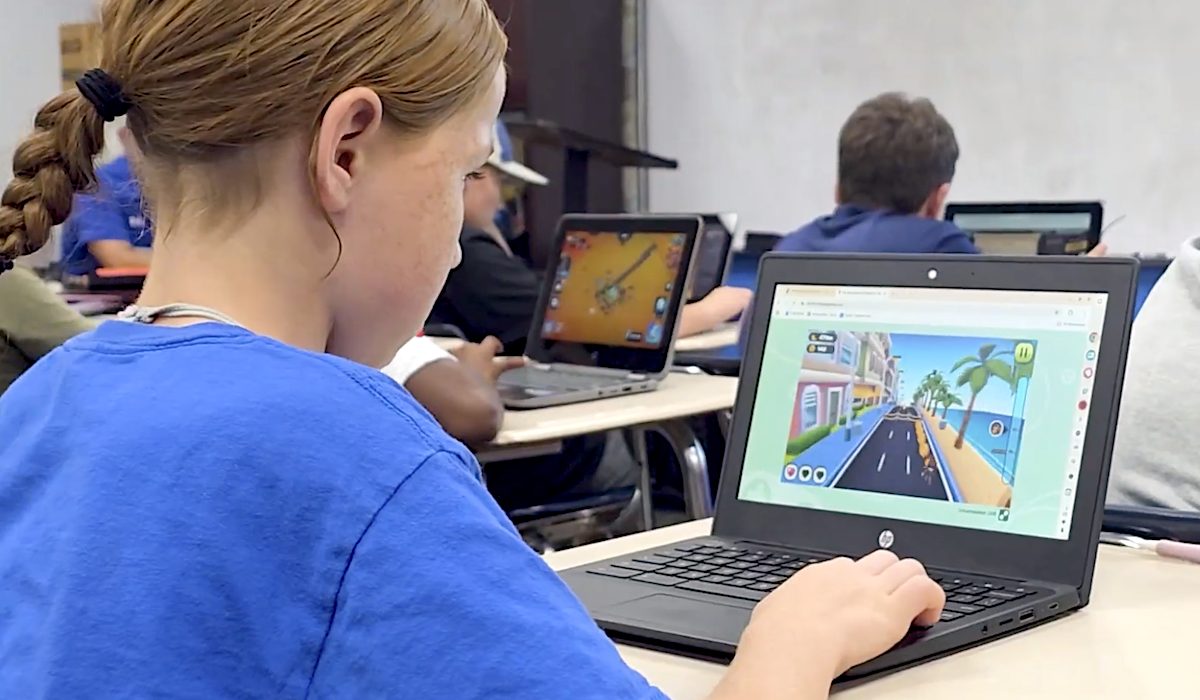

PURCELL — Inside a fifth-grade classroom at Purcell Intermediate School, students are not just answering reading comprehension questions. They are defending digital villages.
On their Chromebooks, students read passages and answer questions through an online literacy platform called Shoelace Learning. Correct answers allow them to strengthen their in-game “dwells,” or home bases, inside the game.
To the students, the experience feels familiar.
One compared the program to Clash of Clans. Another said it reminded him of Subway Surfers. But instead of attacking rival villages or dodging trains, the only way to advance is to read — and understand — the text in front of them.
Platforms like Shoelace Learning are part of a growing effort to address a persistent challenge in Oklahoma schools: Students who fall behind in reading, particularly after early elementary grades, often struggle to catch up.
“Particularly right now, I would say the biggest gaps are in adolescent literacy,” said April Grace, executive director of the Oklahoma Public Schools Resource Center.
For many struggling readers, the issue extends beyond simple skill gaps. It also involves disengagement.
“Engagement is the intervention,” said Shoelace Learner founder Julia Rivard Dexter.
In intervention teacher Dawn Perigo’s classroom, students alternate between reading passages and answering comprehension questions that determine how much progress they can make in the game. Some students keep physical books beside their laptops as they work.
One Purcell student who demonstrated the game said he enjoyed reading and pointed to a chapter book on his desk. The title appeared to be a higher-level young adult book, more advanced than what might typically be expected of a fifth grader.
Several other students had books next to them, suggesting their interest in reading had extended beyond the digital realm.
Asked whether they enjoyed reading more after using the program, roughly a quarter of the students in the room raised their hands.
The informal feedback was far from scientific, but it offered a glimpse into how some students perceive impact of the program’s gamified literacy approach.
‘Swiss cheese learning’: Addressing adolescent literacy gaps

Platforms like Shoelace Learning are emerging as educators grapple with the persistent challenge of schoolchildren falling behind early in reading and remaining behind as academic demands increase. Recent state test results show that nearly three in four Oklahoma students are not proficient in reading by the end of third grade, with proficiency rates dropping to about 21 percent by eighth grade.
This year, those poor results spurred the Oklahoma Legislature to pass financial investments, science of reading initiatives and early literacy reforms, such as retention parameters for elementary students who fall shy of proficient marks on state tests.
Much of this year’s conversation and negotiation focused on elementary grades, with the goal of ensuring students are proficient by third grade. However, educators note that older students who fall behind often have fewer targeted supports available.
“If you do not have [adequate literacy skills], you are going to have learning loss in any subject that you are presented in school,” Grace said.
To address such gaps, OPSRC partnered with Shoelace Learning to pilot a program designed specifically for older students who are struggling as readers.
The platform embeds individualized reading exercises inside game-based environments. Students read passages and answer comprehension questions to earn in-game rewards, such as buildings or improvements to their digital “dwells,” creating a direct connection between reading performance and gameplay progress.
Rivard Dexter, Shoelace’s founder, said traditional approaches have often emphasized delivering curriculum rather than motivating students to engage with it.
“We are not focusing on engagement (as a system),” she said. “We are focusing on curriculum and content, and we have thrown so much at teachers and students over the years, and it is just not moving the needle.”
At the core of her company’s platform sits the idea that literacy growth requires both skill development and motivation.
Rivard Dexter described many struggling readers as having experienced what she calls “Swiss cheese learning,” where skill gaps accumulate over time. As a result, Shoelace Learning’s platform attempts to identify and address those gaps in real time.
“Based on where the kids are struggling, we can insert interventions in the moment,” Rivard Dexter said.
Grace said pilot schools that implemented the platform have consistently reported strong engagement.
“The schools that have used it and done it with fidelity have just been super excited about it,” Grace said.
How schools are using the platform

At Purcell Intermediate School, educators say the Shoelace Learning platform has helped them identify reading gaps and tailor instruction to individual students.
Principal Tina Swayze said the school began piloting the platform after teachers expressed a need for better intervention tools.
“The reason that we started with this in the very beginning was our teachers were needing intervention,” Swayze said. “Where do I go to find a focused intervention piece that kids would (use to) drive their learning?”
The Shoelace Learning platform offers two programs or games — Dreamscape and Dreamseeker Drift — that assess students’ reading levels and track comprehension skills over time, allowing teachers to identify where students need additional help.
“The whole purpose is to close that gap,” Swayze said. “Or if they are already at that level, we want them to extend it.”
Dawn Perigo, a fifth-grade language arts teacher who works with about 120 students in intervention groups, said the Shoelace Learning platform simplifies the process of identifying gaps.
“It gives them a baseline test so you know where they are at, and it reports back to me so I can monitor them,” Perigo said. “If they are not doing well in a skill, I can pull them and work with them.”
The system’s data tools also help teachers manage large numbers of students.
“There is a lot of data we look at,” Perigo said. “This really helps pinpoint certain areas.”
Fifth grade reading teacher Tammie Mackey said Shoelace Learning allows teachers to tailor assignments to students at different reading levels.
“I can give them assignments that are very specific to whatever literacy skill we might be working on,” Mackey said. “If Dawn is intervening with two or three students that I have in this hour, I can choose to give them a third-grade or fourth-grade assignment in the same skill.”
The school began testing the program during a literacy tournament last year, and teachers said they quickly saw measurable gains. They said engagement, especially among students who struggle with traditional reading assignments, is one of the platform’s biggest advantages.
“My class has grown about a grade and two months worth,” Mackey said.
Some students have shown even larger gains.
“I have a student who has shown [nearly six] grades of growth,” Mackey said. “I have another girl who has had about [five grades of] growth.”
Mackey said those gains were measured over roughly a school year using the platform’s internal assessment tools, which track changes in reading comprehension levels. While some students show large individual gains, Mackey said the overall class trend reflected steady improvement rather than dramatic jumps.
“No one has gone backwards,” she said.
Measuring engagement and growth
During a three-week literacy tournament earlier this year, about 3,000 students across 15 Oklahoma schools used Shoelace’s reading platform. Roughly 2,407 students were considered active, meaning they answered at least one question during the competition. Overall, students answered more than 1.1 million questions during the event.
Shoelace defines sustained participation — what it calls “fidelity” — as answering at least 25 questions per week with an accuracy rate above 50 percent. Students who met that benchmark showed the strongest literacy gains, with average reading comprehension growth equivalent to about three months of grade-level progress in the three-week period alone, according to company data.
Across all participants, average growth was smaller but still measurable, suggesting more modest gains among less consistent users.
Company representatives cautioned that those metrics are based on the platform’s internal assessment system and are not directly comparable to statewide testing benchmarks.
In Purcell, Mackey’s classroom averaged about 1.6 reading comprehension levels of growth over roughly a year and a half of consistent use.
The program costs about $15 per student for the year. In Oklahoma, because of the company’s partnership with OPSRC, that cost is $8 per student, according to Rivard Dexter. While the cost is lower than many high-intensity tutoring and intervention models, it still requires a significant investment for districts scaling their literacy supports.
Grace said one advantage of the platform involves the volume and immediacy of feedback teachers receive. Those responses provide a large data set for tracking student progress in real time.
“The insightful data that they get back from those reports helps them get another level of insight alongside other tools and other things that are obviously done in a classroom,” Grace said.
Follow @NonDocMedia on:
Facebook | X | Text or Email
Lawmakers weigh literacy strategies

At the Oklahoma Capitol, improving reading outcomes remains a central focus of education policy debates.
As schools explore digital learning tools, some lawmakers are simultaneously raising concerns about excessive screen time for students. HB 4358, which was introduced this year but never received a vote on the Senate floor, would limit screen time for students in pre-K through fifth grade to one hour per school day. If a similar bill were to become law in a future session, such a policy could impact how digital tools are used in classrooms.
But educators in Purcell say the Shoelace platform requires relatively limited screen time. The company itself recommends about 25 to 30 minutes of use across a five-day school week, giving teachers flexibility in its deployment alongside traditional reading instruction.
Teachers say some students even use the platform at home, applying it toward their allotted daily screen time.
“I have heard some of my fifth graders say, ‘Well, I am allowed an hour each school day of screen time, so I take 20 minutes of my hour for Shoelace,'” Mackey said. “That is a huge win, because that is 20 minutes you are not on TikTok and Instagram.”
This session, lawmakers passed an overhaul of the Strong Readers Act that seeks to improve early elementary literacy by enhancing intensive intervention practices. SB 1778 also altered the formula for SRA funds to incentivize improvement, and it reintroduced retention for struggling readers in third grade, a mechanism lawmakers have consistently characterized as a “last resort.” Gov. Kevin Stitt signed the bill into law April 21.
“It is all about literacy,” said Rep. Ronny Johns (R-Ada), a former educator. “It is all about reading scores and where that shakes out.”
Johns said districts should have flexibility to adopt innovative approaches if they show evidence of improving student outcomes.
“If schools can find a program that works, then we need to be able to let them do that,” he said.
He also emphasized that literacy challenges often begin well before third grade, repeating a common message: “You learn to read until the third grade, and then after the third grade, you are reading to learn.”
Rep. Jacob Rosecrants (D-Norman), also a former teacher, said he would approach dramatic claims of literacy improvement with caution.
“If there was a silver bullet like that, it would be wonderful,” Rosecrants said. “But what are we basing the success on? Is it test scores? Is it growth?”
He said Oklahoma’s education system has become overly focused on testing, rather than fostering a love of reading.
“I would like to just see kids love reading again,” Rosecrants said.
That goal aligns with Shoelace Learning’s gamified approach. Still, Purcell educators emphasize that the program works best as part of a broader literacy strategy that includes independent reading, classroom instruction and teacher guidance.
“I think any reader you make stronger starts to find that love,” Perigo said. “But the teacher still needs to be there to nurture the love.”
For students building digital dwellings in Perigo’s classroom, the game may simply be a new doorway into reading — one question a time.
(Correction: This article was updated at 5:45 p.m. Monday, July 13, to correct reference to the price point of Shoelace Learning’s platform for school districts.)