


The Osage Nation is asking the 10th Circuit Court of Appeals to reconsider its 2010 decision in Osage Nation v. Irby and declare that its Indian Country reservation was never disestablished.
The new case, Osage Nation v. Taylor, argues the 2010 decision is incompatible with the 2020 McGirt v. Oklahoma decision, which fundamentally changed how courts in the United States analyzed questions of reservation disestablishment.
Before the McGirt decision, the leading case on Indian Country reservation disestablishment was Solemn v. Bartlett, a 1984 decision involving the Cheyenne River Sioux Reservation in South Dakota. Solemn established three factors that courts would examine to determine whether a reservation was disestablished: the text of acts of Congress, the “circumstances surrounding passage of the act(s)” involving the reservation, and the “post-enactment history” of the reservation.
The McGirt decision is broadly understood to have narrowed the Solemn factors to focus solely on the text of the acts of Congress, an analysis both originalist and to the benefit tribal governments. Prior to McGirt, arguments about demographic changes and land status were given greater weight under Solemn’s third factor, which the Osage Nation argues was dispositive in the prior decision that said their reservation was disestablished.
“This court’s decision in Irby and the Supreme Court’s decision in McGirt cannot stand together. They apply different legal tests to the same question — whether Congress disestablished a reservation — and they reach incompatible conclusions about what evidence may support a disestablishment finding,” attorney Eugene Bertman wrote for the Osage Nation. “Irby relied on extratextual evidence as an independent ground for finding disestablishment, after concluding that no statutory text supported it. McGirt held that extratextual evidence may not do that work.”
Solicitor General Gary Gaskins has responded on behalf of the Oklahoma Tax Commission, the opposing party in the Osage Nation’s suit, arguing the Irby case was rightfully decided and that the Osage Nation Reservation was disestablished.
“If this court were to go to the merits, it should hold that Irby remains good law even in light of McGirt. McGirt disclaimed any application to the Osage Nation. And McGirt did not purport to establish a new legal test for disestablishment. McGirt, that is, did not repudiate the Solem test utilized by this court in Irby,” Gaskins argued. “Thus, in Irby this court did exactly what McGirt now requires; the court found the relevant statutes ambiguous before turning to circumstances surrounding their passage to resolve the ambiguities. Accordingly, McGirt does not repudiate Irby’s reliance on the Solem test or consideration of extratextual evidence in the face of statutory language which is ‘not unambiguous.'”
The case comes before the federal appellate court on a procedural motion, meaning judges could decide the case without deciding the status of the Osage Reservation. The nation has requested oral arguments, while the state did not. No oral argument order has been issued as of the publication of this article.
Osage Reservation’s unique history
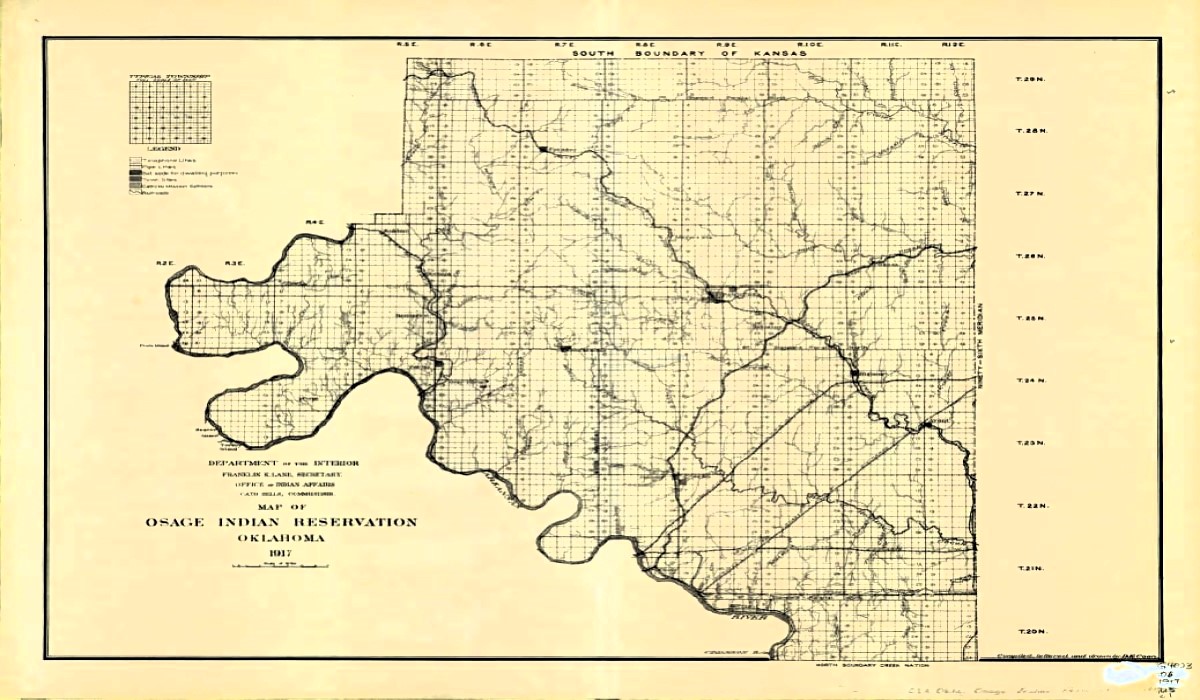
The new case comes after the Oklahoma Court of Criminal Appeals cited the Irby decision in 2024 to find that the Osage Nation Reservation — which spans the entirety of Osage County — does not exist for purposes of criminal jurisdiction following the McGirt decision.
In McCauley v. State, the Oklahoma Court of Criminal Appeals’ then-Vice Presiding Judge Robert Hudson wrote for a unanimous court to find that the Irby decision was the controlling precedent.
“The 10th Circuit’s decision in Osage Nation applies here because of its preclusive effect,” Hudson wrote. “Appellant’s claim is entirely derivative of the Osage Nation’s original claim, and as such cannot be relitigated here by appellant.”
The OCCA’s decision in the McCauley case has largely kept criminal cases involving Indian defendants accused of crimes within Oklahoma’s largest county in Osage County District Court instead of in the Osage Nation’s courts.
But for Oklahoma historians, the notion the Osage Reservation did not survive the 20th century while the reservations of the Five Tribes did can be a bit perplexing. At statehood, the Osage Reservation was the only Indian Reservation required to be its own county, and it was one of the last reservations allotted. The unique “underground reservation,” where the tribal nation retains the mineral rights in Osage County, also points to the tribe’s special status in Oklahoma.
The Osage Nation’s history is unique amongst tribes in Oklahoma. As the United States grew from a set of colonies into an expanding nation in North America, tribal nations were pushed west, through both forced removal and migration away from encroaching settlers. One of the most immediate problems with the attempts of eastern tribes to move west involved the fact other tribes already inhabited the region.
Before the United States could secure Oklahoma as a destination for Indian Removal, the federal government had to negotiate with the Osage Nation, which by that point was armed through trade with French and Spanish explorers. The Osage had come to dominate large swaths of Missouri, Arkansas, Oklahoma and Kansas by the 1750s.
By 1839, the nation was forced onto a reservation in Kansas. But by the 1870s, Kansas settlers were demanding further removal. The Osage Nation was required to purchase its current reservation south of the Kansas border — which was previously Osage territory before the United States utilized it for Indian removal — from the Cherokee Nation in 1883.
Historically, the Osage Nation consisted of several clans or sub-tribes each with their own hereditary chief, but by 1869 the last Osage heriditary chief had died, according to Terry Wilson’s The Underground Reservation. In 1881, the nation adopted its first written constitution alongside the now familiar office of principal chief.
AG’s relationship with Osage Nation

Gaskins’ signing of the new brief appears to indicate the Attorney General’s Office is handling the Osage Nation’s appeal in-house. While it is normal for the Attorney General’s Office to handle appeals on behalf of the state, some other pending appeals involving federal Indian law like the Kunzweiler v. Muscogee Nation case are being represented by private counsel.
Attorney General Gentner Drummond, whose family is one of the largest landholders in Osage county, has publicly opposed efforts to overturn the Irby decision.
“I do believe that the law is settled. I do believe in the case of the Osage that the jurisdictional boundaries have been dissolved — from just a strict legal position,” Drummond told Osage News in 2025. “I believe that Irby was rightly decided. I fully respect and acknowledge the sovereignty of the Osage Nation and will always take steps and actions consistent with it, notwithstanding the jurisdictional boundary issue.”
Drummond’s family has been entwined with the Osage Nation since his ancestor, Frederick Drummond, settled in the nation in 1887. A review of Newspaper.com records shows Drummond family members were estate administrators for at least 15 Osage citizens, guardians for at least seven Osage citizens, and held various other legal relationships with tribal citizens during the Osage Reign of Terror in the 1910s through as late as 1930.
Gentner Drummond appears to have been somewhat unaware of the extent of his family’s legal involvement in Osage citizens’ affairs prior to a 2022 podcast by Bloomberg.
“Oh, I’m a realist. We only pass along the good stories, we don’t pass along the bad stories typically, so it would not surprise me at all if there are bad stories out there that would not have been the subject matter of the family lore passed down,” Drummond said in 2022.
Despite his family’s complicated relationship with the Osage Nation, Drummond has campaigned as the tribal-friendly candidate during this year’s Oklahoma gubernatorial election, and he has frequently pushed for better relations with tribes.
During a Republican gubernatorial debate in late May, Drummond was the only candidate not to support the state having concurrent jurisdiction to prosecute Indian defendants within the Indian Country reservations affirmed across eastern Oklahoma by the McGirt decision. Instead, Drummond offered an ambitious plan to compact with tribal governments and allow Oklahoma district attorneys and judges to prosecute and adjudicate cases in the name of tribal governments using Oklahoma’s court resources.
He claimed the Chickasaw, Choctaw and Cherokee nations would sign such a compact if he were elected governor.
“What they can do instead of spending the billions of dollars — which they are not spending yet — on courthouses, prosecutors and judges, they can spend on health care and mental health, and we can partner with them in that,” Drummond said. “So the solution is the state of Oklahoma doing it in the name of the tribe showing respect, courtesy and comity.”