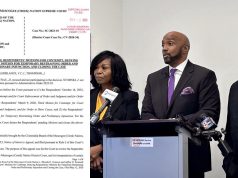


By a 13-1 vote, the Muscogee National Council approved a resolution April 25 expressing “no confidence” in Muscogee Nation Supreme Court Justices Andrew Adams III, Richard Lerblance, Montie Deer, Kathleen Supernaw and George Thompson Jr. for having “violated their oath of office by independently amending the 1979 Constitution by striking ‘by blood’ without an affirmative vote of the people.”
The resolution escalates the conflict among the Muscogee Nation’s three branches of government over the status of the descendants of Muscogee Freedmen, or people of African descent enslaved by some Muscogee citizens prior to the Civil War.
The move appears to signal that the Muscogee National Council is not interested in implementing the the Muscogee Nation Supreme Court’s ruling last year that directed the nation to grant citizenship to the descendants of Muscogee Freedmen. The ruling also ordered the striking of “by blood” language from the nation’s laws, which the court found to be incompatible with the Treaty of 1866‘s promise that Muscogee Freedmen be granted tribal citizenship after the Civil War.
The Muscogee Supreme Court’s ruling came shortly before the 2025 Muscogee elections and led to brief speculation Muscogee Freedmen would be allowed full participation in tribal politics for the first time in half a century, but Principal Chief David Hill issued an executive order instructing the Muscogee Nation Citizenship Office to “not issue citizenship cards or any form of membership identification cards” to Freedmen applicants until the nation reviews and amends its laws and regulations to comply with the court’s order.
Hill’s administration has argued the nation’s laws must be amended by the Muscogee National Council before the Supreme Court’s order can be implemented, and while the Muscogee Nation Attorney General’s Office has drafted new citizenship laws that would require Freedmen descendants to prove lineal descent from someone on the 1869 Dunn Roll, the council has not taken up the legislation. Attorneys representing Muscogee Freedmen have argued Hill has authority to grant citizenship cards and that blaming the legislature is deflection.
Regardless of whether Hill could implement Freedmen citizenship without legislative approval, Saturday’s “no confidence” vote sends a fairly clear signal that a majority of the nation’s legislative branch is not interested in complying with the Supreme Court’s ruling.
Barnett calls resolution ‘an impotent gesture’
The resolution was authored by Tvlse District Rep. Lucian Tiger, who rejoined the council after the 2025 elections. It was cosponsored by Reps. Mary Crawford, Sandra Golden, William Lowe, Anna Marshall and Darrell Proctor.
“Five individuals cannot remove or add language to our constitution,” Tiger said while introducing his resolution. “And also to add to that, district court judges, supreme court judges, chief, second chief, council (members) — we take an oath of office at our swearing in.”
During the resolution’s debate, Rep. Dode Barnett questioned the effectiveness of the action when Supernaw had already retired from the court. Speaker Randall Hicks clarified both Supernaw and Deer had retired.
“I know our nation is frustrated right now, and I’m sure that this body is frustrated as well, and I just keep going back — not to relitigate the case — but I mean, we couldn’t make the case in our own court system,” Barnett said. “The justices make the best decision they can with the information that they are presented with. I don’t know that they should be punished — and this isn’t really a punishment, it’s more of an impotent gesture because it doesn’t really change anything — but I don’t know. Justice Thompson has given his life to the service of our people, and I don’t think that I have a right to question his motives or his decisions personally.”
Tiger clarified he intentionally included retired justices.
“The reason Judge Supernaw as well as Judge Deer are mentioned in this is because they were a part of the ruling for the amendment to remove language from the constitution,” Tiger said.
Barnett also argued the resolution would hamper the nation’s goal of “unity” after last year’s court ruling.
“One of the things we were asked for last year is unity, and I just can’t get behind this,” Barnett concluded. “But thank you for allowing me to share my thoughts.”
In support of the resolution, Golden argued the justices had overstepped their authority and violated the trust of the Muscogee people.
“Me, I support this because it says the people that made this decision — we entrusted them — and the people who signed it, these people, we entrusted them, and they cannot overstep their authority,” Sandra Golden said. “It says in our constitution that they cannot do what they did.”
Tiger, Crawford, Lowe, Golden, Marshall and Proctor were joined by Reps. Galen Cloud, James Factor, Lora Harjo-King, Robert Hufft, Charles McHenry, Thomasene Osborn and Cody Phillips in passing the legislation. Barnett was the sole vote against the resolution, while Rep. Robyn Whitecloud abstained and Hicks did not vote.
Hill creates ‘Mvskoke Citizenship Integrity Protection Commission’
On April 20, Hill issued an executive order establishing the Mvskoke Citizenship Integrity Protection Commission to “conduct an in-depth analysis” and “determine the impact to nation governmental programs, services and operations” posed by Freedmen citizenship.
“The commission should conduct an in-depth analysis on this issue so that the executive and legislative branches will be properly informed as they make critical budgetary decisions that may impact services to all citizens and for maintaining key public safety priorities in the nation’s reservation,” the order states.
The commission’s meetings and the documents produced by it will not be open to the public, the order states.
Hill’s order leaves enough ambiguity for both a supporter and opponent of implementing Freedmen citizenship to find hope or despair. While the order makes repeated reference to a future implementation of the court’s ruling, it also says the “decision is inconsistent with the constitution.”
A few days after Hill’s executive order, three new status reports were filed with the Muscogee Nation Supreme Court in the Freedmen citizenship case on behalf of the citizenship board, Hill and Attorney General Geri Wisner. Motions previously filed by the Freedmen plaintiffs, which would hold Hill in contempt and potentially delay the 2026 Muscogee special elections, are currently pending before the court.
The Citizenship Board told the court it wrote its own proposed citizenship code amendments — which replaced the requirement to prove lineal descent from the Dunn Roll with a requirement to prove lineal descent from the Dawes Rolls — and sent them to Hicks, the council’s speaker, March 23. The board’s attorneys also acknowledged their client was “unaware” of a national councilor willing to sponsor the legislation.
The Attorney General’s Office acknowledged that Wisner’s team had drafted the proposed amendments, which would require proving lineal descent from the Dunn Roll. Wisner’s office argued its job was to prepare proposed amendments, while either the citizenship board or Hill’s office would have the final role of finding a legislative sponsor.
In the principal chief’s motion, Hill’s attorneys objected to being required to submit a status report to the court and informed the court of his most recent executive order.
“As a non-party, Chief Hill objects to being required to respond to any order of this court that applies to actual parties in this action,” Hill’s attorneys wrote. “Based on this preliminary information (on the number of Muscogee Freedmen potentially eligible for citizenship), Chief Hill determined that a more focused and responsible approach to prepare for an influx of new citizens would be to establish a formal commission to investigate these issues and provide an in-depth analysis and report to Chief Hill and the National Council by a date certain.”
His office also acknowledged the citizenship board’s proposed legislation but noted the board “did not obtain concurrence” with Hill before forwarding their draft to the speaker and that there did not appear to be a sponsor for the board’s legislation.
More than nine months after the court’s ruling in favor of descendants of Muscogee Freedmen, none have been enrolled as tribal citizens.
Citizens of the Muscogee Nation are currently set to vote on four constitutional amendments during a May 30 special election, according to Mvskoke Media. The amendments range from the symbolic removal of the word “Creek” from the nation’s constitution, to term limits for Muscogee National Council representatives and a change that would allow the principal chief to make special justice appointments for the Supreme Court.